Taking elevators
Navigation continues through vertical transitions common in stations, malls, and hospitals.

Technology
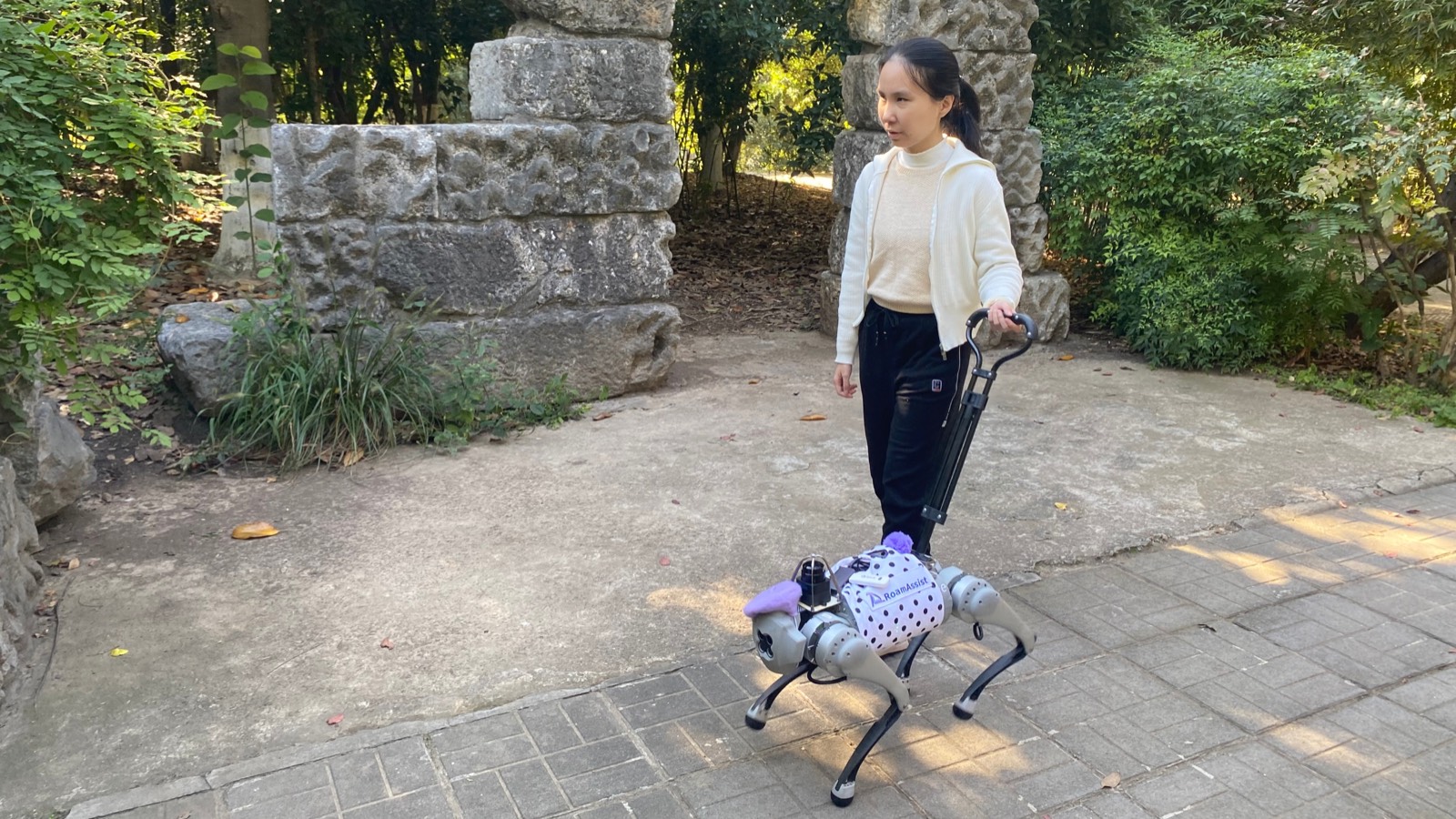
Our patented topo-navigation algorithm and user-centered interactive system turn an off-the-shelf robot dog into an intelligent, self-propelled companion.
How it works
The robot not only has a map of the environment, but stays constantly aware of moving obstacles — pedestrians, vehicles, and other traffic — and smoothly guides the user around them while following the optimal path. It is as easy as holding the arm of a friend.
The person remains in the loop. They can add or change destinations, control walking speed, and take the lead in tight spaces such as opening a door or entering an elevator. The user can also steer the robot; it coordinates with those instructions instead of taking over.
Capabilities
Navigation continues through vertical transitions common in stations, malls, and hospitals.
The system supports environmental interactions, not only point-to-point walking.
Handle-based control keeps the interface physical, immediate, and low in cognitive load.
Environmental perception helps users move around people and objects without stopping at every turn.
Route cues help users know where they are, which is essential in large, repetitive interiors.
A practical alternative to long waitlists: easier to maintain and more available at scale.
Research
The work behind RoamAssist is published at CHI and HRI, including a CHI 2024 Honorable Mention for guiding visually impaired people in diverse environments.